Consumer Promotion
Consumer Promotions: Complete Guide for Brands | Mobikonnect
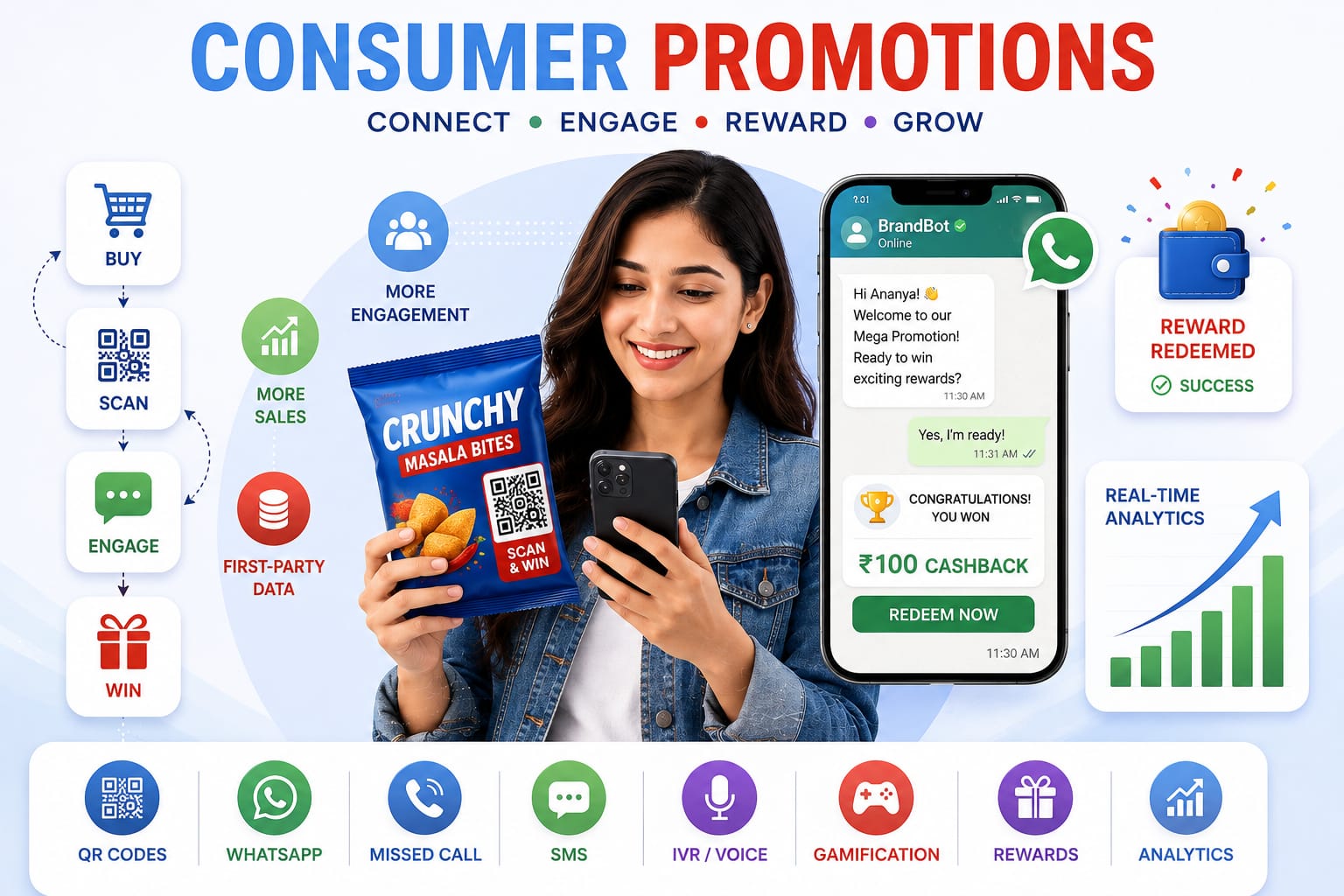
Learn how consumer promotions drive sales, engagement, loyalty and first-party data. Explore promotion mechanics, technology, rewards and real campaign examples.
Consumer Promotions: The Complete Guide for FMCG and Consumer Brands
A good consumer promotion is not simply about giving away a discount or putting a lucky-draw sticker on a product.
Done properly, a consumer promotion can do much more: increase product sales, encourage trial, generate repeat purchases, create consumer engagement, collect first-party data and build a stronger relationship between the consumer and the brand.
The difference is in how the promotion is designed.
A ₹20 cashback offer, a QR-based Scan & Win campaign, a missed-call contest, a WhatsApp promotion and a loyalty program may all look different on the surface. But the objective behind each can be the same: give the consumer a reason to choose your brand and give the brand a reason to continue the conversation.
For FMCG and consumer brands, that is where consumer promotions become powerful.
This guide explains what consumer promotions are, how they work, the different promotion mechanics brands can use, the technology that powers them, how rewards should be designed and—most importantly—how to measure whether a promotion actually delivered business value.
What Is a Consumer Promotion?
A consumer promotion is a marketing activity designed to encourage consumers to purchase, try, engage with or repurchase a product by offering an additional incentive or experience.
The incentive could be:
Cashback
Discount
Coupon
Gift
Instant reward
Lucky draw
Scratch & Win
Contest
Game
Loyalty points
Product sample
Exclusive experience
Referral reward
The important point is that a promotion should have a clear consumer action attached to it.
For example:
Buy → Scan → Participate → Win
or
Buy → Enter Code → Receive Cashback
or
Missed Call → Register → Play → Win
or
Purchase → Earn Points → Redeem Reward
The technology may change, but the underlying objective remains the same: move the consumer from awareness to action.
Why Do Brands Run Consumer Promotions?
Brands generally run consumer promotions for one or more of five reasons:
1. Increase Sales
The most obvious objective is to create an additional reason to purchase.
A well-designed promotion can help increase product offtake during a specific period, launch, festive season or competitive situation.
2. Drive Product Trial
For a new product, the biggest challenge is often getting the first purchase.
Sampling, cashback, coupons and trial-based promotions can reduce the perceived risk of trying something new.
3. Increase Repeat Purchase
A promotion doesn't have to end with the first transaction.
Points, cashback, coupons, rewards and gamified loyalty can give consumers a reason to come back.
4. Create Consumer Engagement
A promotion can turn a passive buyer into an active participant.
A consumer who scans a QR code, plays a game, answers a quiz, submits a receipt or interacts through WhatsApp has a much deeper interaction with the brand than someone who simply sees an advertisement.
5. Generate First-Party Data
This is becoming increasingly important.
A well-designed promotion can capture useful consumer information—with appropriate consent and data practices—while giving the consumer a genuine reason to participate.
That means the promotion can become more than a sales activity.
It can become a customer acquisition and engagement engine.
Consumer Promotion vs Advertising
Advertising primarily tries to influence awareness, consideration and brand perception.
Consumer promotions are more directly designed to influence action.
Think of it this way:
Advertising
Brand → Message → Consumer
Promotion
Brand → Offer/Experience → Consumer Action → Data/Participation → Reward
This doesn't mean one is better than the other.
The strongest campaigns often combine both.
Advertising creates awareness.
The promotion gives consumers a reason to act.
The engagement technology makes participation easy.
The reward creates gratification.
The data creates an opportunity for future engagement.
Consumer Promotion vs Trade Promotion
These two are often confused.
Consumer Promotion
The target is the end consumer.
Examples:
Buy & Win
Scratch & Win
Cashback
Scan & Win
Consumer contests
Coupons
Loyalty programs
Trade Promotion
The target is the channel partner.
Examples:
Retailer incentives
Dealer rewards
Distributor programs
Painter loyalty
Plumber loyalty
Mechanic loyalty
Sales-team incentives
Channel contests
The objective also differs.
Consumer promotions generally aim to influence purchase, trial, engagement and loyalty.
Trade promotions aim to influence distribution, availability, recommendation and sell-out.
For many brands, the two should work together.
A retailer needs a reason to push the product.
A consumer needs a reason to buy it.
The promotion strategy should connect both sides of the equation.
The Most Effective Consumer Promotion Mechanics
There is no single promotion mechanic that works for every brand.
The right mechanic depends on the objective, product, audience, price point, distribution, campaign duration and reward budget.
Here are some of the most commonly used mechanics.
1. Buy & Win
The consumer purchases the product and becomes eligible for a reward or lucky draw.
Example journey:
Buy product → Find promotional code → Register → Enter code → Win
This works particularly well when the primary objective is to connect the promotion directly with purchase.
2. Scan & Win
A QR code is placed on the product pack, POS material, advertisement or activation.
The consumer scans it and enters the promotional journey.
Example:
Scan QR → Landing page/WhatsApp → Register → Participate → Reward
The advantage is simplicity.
The consumer does not necessarily need to download an app.
3. Scratch & Win
A scratch card reveals a unique code or reward.
It works because it combines curiosity, anticipation and instant gratification.
Scratch & Win can be used for both consumer promotions and trade incentive programs.
4. Cashback Promotions
Cashback gives the consumer an almost-cash reward after a qualifying purchase.
This is particularly useful when the objective is to create an immediate and tangible value proposition.
Cashback can be delivered through suitable digital wallets, payment mechanisms or other fulfilment methods depending on the campaign design.
The important thing is not simply the cashback amount.
It is the relationship between:
Purchase value → reward value → perceived benefit → repeat behaviour.
5. Lucky Draws
Lucky draws are useful when the brand wants to create excitement around a larger prize.
Instead of giving a small reward to every participant, the brand may offer:
Daily winners
Weekly winners
Monthly winners
Mega winners
The prize architecture should be carefully designed.
A ₹10 lakh prize sounds impressive, but if consumers believe their chance of winning is negligible, participation can suffer.
Sometimes many smaller rewards outperform one enormous prize.
6. Receipt Upload
Receipt-based promotions allow brands to validate purchases before participation or reward issuance.
A typical journey could be:
Purchase → Upload receipt → Validation → Participation → Reward
This can be useful when unique pack codes aren't available or when the brand wants purchase evidence as part of the campaign.
7. Coupon Campaigns
Coupons can be used to:
Drive store visits
Encourage trial
Drive repeat purchase
Generate leads
Reward existing consumers
Support product launches
Digital coupons can also make redemption and campaign tracking easier.
8. Refer & Earn
Existing customers become an acquisition channel.
Customer → Referral → New Customer → Reward
The reward can be given to the referrer, the new customer or both.
The real value is that the brand is using an existing relationship to create another one.
Technology Has Changed Consumer Promotions
This is where the consumer promotion landscape has changed dramatically.
Earlier, many campaigns depended on:
Print → Phone number → SMS → Manual processing
Today, brands can create much more connected journeys using:
QR codes
WhatsApp
Chatbots
SMS
Missed calls
IVR
OBD/voice
Microsites
PWAs
Mobile applications
Interactive video
Gamification
Digital coupons
Reward engines
Analytics
CRM/CDP integrations
AI-powered campaign technology
The technology should never be selected because it is fashionable.
It should be selected because it makes the consumer journey simpler or the business outcome stronger.
QR Codes in Consumer Promotions
QR codes can turn a physical product into a digital engagement touchpoint.
For example:
Product Pack
↓
QR Code
↓
Scan
↓
Campaign Experience
↓
Registration
↓
Game / Contest / Coupon
↓
Reward
↓
Consumer Data
A dynamic QR approach can also provide more flexibility than a static destination when the campaign requires changing experiences, tracking or campaign management.
For brands, the bigger opportunity is not simply the QR scan.
It is what happens after the scan.
WhatsApp Consumer Promotions
WhatsApp can make a promotional journey conversational rather than form-based.
A consumer could:
Scan QR → Open WhatsApp → Start Chat → Submit Code → Play Game → Receive Reward
The same environment can potentially support:
Registration
Coupon distribution
Contests
Surveys
Customer support
Loyalty
Referral
Reward notifications
Campaign communication
For a consumer, this can feel much simpler than downloading an app or navigating a complicated website.
For a brand, it can become another engagement channel within a broader omnichannel campaign.
Missed Call Marketing
Missed calls remain particularly useful when brands want a simple participation mechanism with very low consumer effort.
The journey could be:
Consumer sees promotion
↓
Gives a missed call
↓
System identifies the caller
↓
SMS / IVR / callback / digital journey
↓
Participation
↓
Reward
Missed calls can be particularly useful for mass-market campaigns, sampling, contests, lead generation and voice-led engagement.
And this is not merely theoretical.
Mobikonnect has used missed-call mechanics in campaigns for brands including Cadbury Perk, Dabur and Panasonic, among others.
SMS-Based Consumer Promotions
SMS can still be extremely effective when the participation journey is simple.
A classic example is:
Buy → Find Code → SMS Code → Validate → Participate/Win
Mobikonnect's case-study portfolio includes code-based SMS campaigns for brands such as Britannia, Nestlé, Nescafé, Kohinoor and Cadbury Bournvita.
For example, Britannia's Khao World Cup Jao campaign used pack codes submitted through SMS and accumulated “runs” to create a gamified promotional journey, generating more than 2.7 million registrations according to Mobikonnect's case study.
The lesson is simple:
The channel is not the campaign. The mechanic is the campaign.
SMS was the entry mechanism.
Gamification made it engaging.
Rewards created motivation.
IVR and Voice-Based Promotions
Voice can be particularly useful when brands want to make participation accessible without requiring a smartphone app or complicated digital journey.
A campaign can combine:
Missed Call → Callback → IVR → Quiz → Lucky Draw → Reward
Mobikonnect's Royal Stag campaign used a missed call followed by an IVR quiz to engage fans around a concert promotion, generating more than 10,000 registrations according to the case study.
Voice can also be used for:
Quizzes
Contests
Surveys
Lead qualification
Customer engagement
Notifications
OBD campaigns
Gamification: Turning a Promotion Into an Experience
A consumer doesn't necessarily remember a discount.
They are more likely to remember an experience.
That's why gamification can make a significant difference.
Brands can use:
Spin the Wheel
Quizzes
Scratch & Win
Predict & Win
Memory Games
Leaderboards
Challenges
Treasure Hunts
Badges
Scores
Levels
The objective isn't to make everything a game.
The objective is to make the desired consumer action more interesting and rewarding.
Cadbury Perk's Play & Win campaign is a good example. Consumers could participate through a missed call or microsite and play an obstacle-dodging game, with leaderboard scoring and rewards. Mobikonnect reports 1,200 winners and a ₹10 lakh mega prize for the campaign.
The Role of Rewards in Consumer Promotions
Rewards are often treated as an afterthought.
They shouldn't be.
The reward is one of the strongest psychological drivers of participation.
But bigger is not always better.
A good reward should be:
Relevant
The consumer should actually want it.
Attainable
The consumer should believe there is a reasonable chance of getting something.
Immediate
Where possible, instant gratification can strengthen participation.
Easy to redeem
A ₹500 reward that requires five complicated steps can feel less valuable than a ₹200 reward that arrives instantly.
Economically viable
The reward budget must make sense against the incremental business value generated.
Mobikonnect's current platform proposition includes reward management, reward catalogues and gift fulfilment as part of the end-to-end engagement journey.
How to Design a Consumer Promotion
Before deciding on the technology, answer these questions.
1. What is the business objective?
Is it:
Increase sales?
Launch a product?
Drive trial?
Increase repeat purchase?
Acquire customers?
Generate data?
Clear inventory?
Support a festive campaign?
Increase retailer push?
If the objective isn't clear, the promotion will probably become an expensive engagement exercise.
2. Who is the target audience?
A promotion for:
Gen Z consumers
will not necessarily work the same way as one for:
Retailers, painters or distributors.
The audience should determine the mechanic, communication, technology and reward.
3. What action do you want?
Keep it simple.
Buy → Scan → Play → Win
is easier to understand than:
Buy → Register → Verify Email → Download App → Create Password → Upload Invoice → Wait → Participate
Every additional step creates friction.
4. What is the reward architecture?
Decide:
Instant reward
Assured reward
Daily reward
Weekly reward
Mega prize
Cashback
Coupon
Experience
Loyalty points
A strong campaign often combines multiple reward levels.
5. How will you prevent fraud?
This becomes particularly important for high-value promotions.
Consider:
Unique codes
Code validation
Duplicate detection
OTP validation
Receipt validation
Auditable winner selection
Device/user checks
Campaign rules
Data validation
A successful promotion with poor fraud controls can become a serious financial and reputational problem.
The Consumer Promotion Funnel
A well-designed campaign should be thought of as a funnel.
1. Awareness
Consumer sees the campaign
↓
2. Interest
Consumer understands the benefit
↓
3. Participation
Consumer enters the campaign
↓
4. Validation
Purchase/code/receipt is validated
↓
5. Engagement
Consumer plays, answers, shares or completes the activity
↓
6. Gratification
Consumer receives reward
↓
7. Retention
Brand continues the relationship
↓
8. Measurement
Brand understands what happened
This is why modern consumer promotions are increasingly becoming data-driven engagement platforms rather than simple promotional offers.
How to Measure Consumer Promotion ROI
This is where many campaigns go wrong.
Brands often report:
“We received 5 lakh participants.”
That's a campaign metric.
It isn't necessarily a business result.
A stronger measurement framework looks at:
Participation Metrics
Registrations
Participation rate
Completion rate
Unique participants
Repeat participants
Sales Metrics
Incremental sales
Product offtake
Units sold
Average order value
Repeat purchase
Engagement Metrics
QR scans
WhatsApp conversations
SMS entries
IVR interactions
Game participation
Coupon redemption
Customer Metrics
New customers
Repeat customers
Retention
Referral
Customer lifetime value
Financial Metrics
Cost per participant
Cost per acquisition
Reward cost
Campaign cost
Incremental revenue
ROI
The ultimate question should be:
Did the promotion create enough incremental business value to justify the investment?
Five Common Consumer Promotion Mistakes
1. Starting With Technology
“We need a WhatsApp chatbot.”
Why?
Technology should solve a business problem—not become the business problem.
2. Making Participation Complicated
Every unnecessary step reduces participation.
3. Choosing Rewards Without Understanding the Audience
The most expensive reward isn't automatically the most motivating reward.
4. Measuring Participation Instead of Business Impact
Millions of registrations sound impressive.
But what happened to sales?
5. Ending the Relationship After the Reward
This is perhaps the biggest missed opportunity.
The promotion should be the beginning of the relationship, not the end.
The consumer has already interacted with the brand.
That is the point where loyalty, personalised communication, referrals and repeat purchase opportunities can begin.
Real Consumer Promotion Examples
Mobikonnect's case-study portfolio provides several useful examples of how different mechanics can be combined.
Britannia — Bread Better Toh Offer Better
Consumers entered unique pack codes and received Paytm cashback, with a daily gold-coin draw. Mobikonnect reports 25% sales growth during the 30-day campaign.
Mirinda — Cashback Promotion
Consumers used product codes to claim ₹10–₹30 cashback, with Mobikonnect reporting 40 lakh+ participants and ₹10 crore in vouchers.
Cadbury Perk — Play & Win
A missed call or microsite led consumers into a gamified experience with leaderboard scoring, a ₹10 lakh mega prize and 1,200 winners.
Dabur — Dant Rakshak Sampling
Consumers gave a missed call, received an SMS link and could claim a product sample. Mobikonnect reports 2.5 lakh missed calls and 1 lakh samples distributed.
Mattel — Toy Blast
A code-based promotion combined purchase, rewards and a Volkswagen Polo grand prize; Mobikonnect reports the campaign also received two Gold Awards at ACEF 2020.
These examples demonstrate an important point:
There is no single “best” consumer promotion mechanic.
The best mechanic is the one that fits the objective, audience, product, purchase journey and reward economics.
How Mobikonnect Approaches Consumer Promotions
At Mobikonnect, we believe the campaign should be designed end to end, rather than treating strategy, technology, engagement and rewards as separate pieces.
The current Mobikonnect platform brings together consumer promotions, trade promotions, loyalty, experiential marketing, customer engagement and martech capabilities.
That can mean combining:
Strategy
→ Campaign idea
→ Promotion mechanic
→ Technology
→ Consumer journey
→ Reward architecture
→ Data capture
→ Fraud controls
→ Analytics
→ Reward fulfilment
The technology stack can include QR and unique codes, WhatsApp, SMS, voice, IVR, interactive video, loyalty technology, reward platforms, analytics, database/CDP capabilities and AI campaign technology, depending on the campaign requirement.
The objective is simple:
Make participation easy for the consumer and make the campaign measurable for the brand.
Frequently Asked Questions
What is a consumer promotion?
A consumer promotion is a marketing activity designed to encourage consumers to purchase, try, engage with or repurchase a product through an incentive, reward or interactive experience.
What are the most common types of consumer promotions?
Common mechanics include Buy & Win, Scan & Win, Scratch & Win, cashback, coupons, lucky draws, contests, receipt uploads, referral campaigns and loyalty programs.
Are consumer promotions only about discounts?
No. Modern consumer promotions can use cashback, rewards, games, experiences, contests, loyalty points, coupons and personalised engagement rather than simply reducing the product price.
How can QR codes be used in consumer promotions?
QR codes can connect physical packaging or promotional material to a digital campaign journey such as registration, Scan & Win, contests, coupons, games, loyalty or reward redemption.
Can WhatsApp be used for consumer promotions?
Yes. WhatsApp can support campaign registration, conversational engagement, code submission, coupon distribution, contests, loyalty and reward communication, depending on the campaign design and applicable platform policies.
How does missed-call marketing work?
A consumer gives a missed call to a campaign number. The system can then trigger an SMS, callback, IVR journey or another digital experience, depending on the campaign objective.
How do brands measure consumer promotion success?
Brands should look beyond participation and measure metrics such as incremental sales, repeat purchase, participation, redemption, customer acquisition, engagement, reward cost and overall campaign ROI.
How much does a consumer promotion campaign cost?
There is no single cost. It depends on campaign duration, audience size, technology, participation mechanism, rewards, fulfilment, communication, creative requirements and campaign complexity. A simple SMS promotion and a nationwide QR + WhatsApp + gamification campaign will have very different cost structures.
Final Takeaway
A consumer promotion should not be designed around the question:
“What offer should we give?”
The better question is:
“What consumer behaviour are we trying to change, and what experience will make the consumer want to take that action?”
Once that is clear, the rest follows:
Objective → Audience → Mechanic → Technology → Reward → Engagement → Data → Measurement → Retention
That's the difference between a promotion that simply generates participation and one that can actually contribute to sales, customer acquisition, loyalty and long-term brand growth.
Planning Your Next Consumer Promotion?
Mobikonnect helps brands design and execute technology-driven consumer promotion campaigns—from campaign strategy and mechanics to QR/WhatsApp/SMS/voice engagement, gamification, rewards, data capture, analytics and fulfilment.